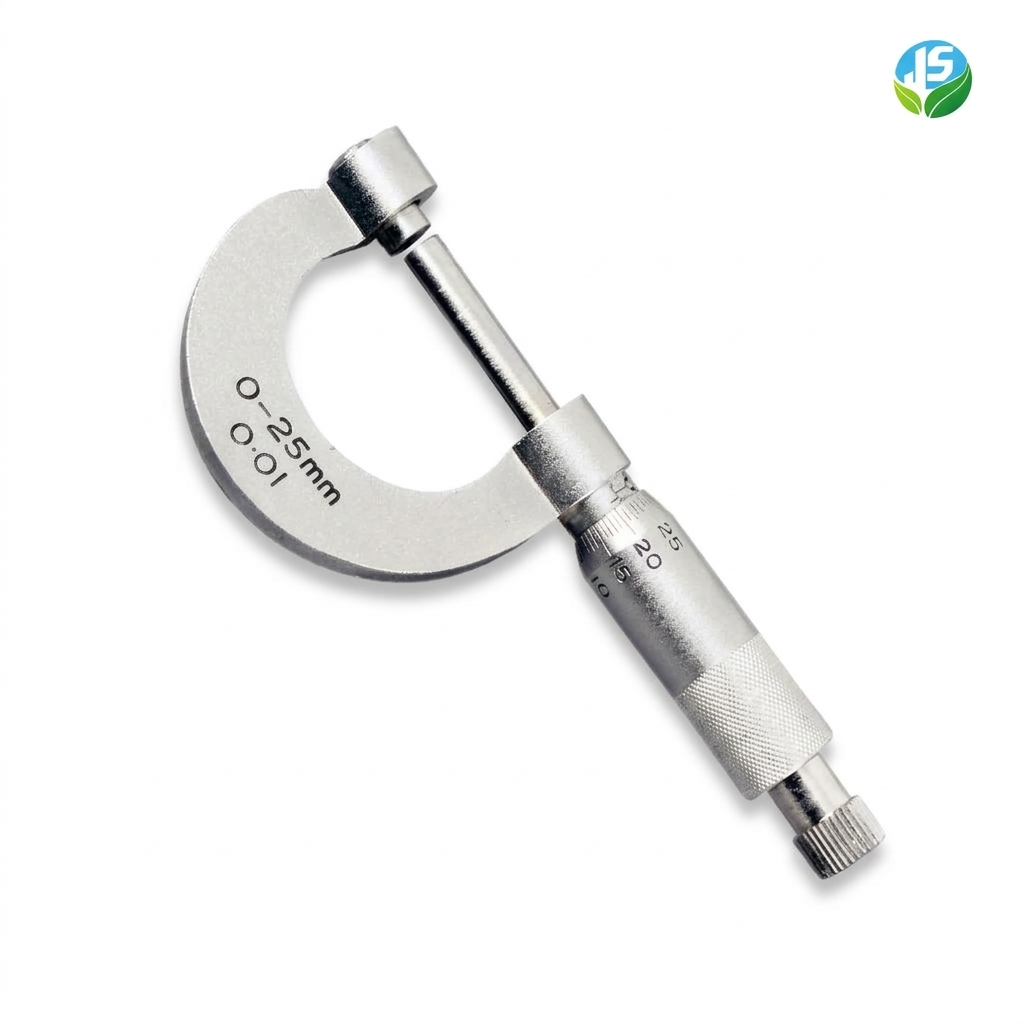
The micrometer, also known as a micrometer screw gauge, is a precision measuring instrument that offers higher accuracy than a vernier caliper. It can measure lengths with a precision of 0.01mm, and with estimation, readings can be taken to the thousandth of a millimeter—hence the name “micrometer”.
Its working principle is based on the screw amplification mechanism: when the spindle rotates one full turn within the nut, it advances or retreats by one pitch (typically 0.5mm). The thimble is divided into 50 equal divisions around its circumference, with each division representing 0.01mm of linear displacement.
Micrometers are generally classified into mechanical and electronic types. Common varieties include outside micrometers, inside micrometers, depth micrometers, thread micrometers, and wall-thickness micrometers, widely used in machining, material testing, and scientific research for precise dimensional measurement. The tool was patented by French inventor J.L. Palmer in 1848 and was first commercially manufactured by Americans J.R. Brown and L. Sharpe in 1869.